
Planning for the future can feel overwhelming, especially when you’re faced with different retirement accounts and investment options. If you’ve ever wondered whether a gold IRA or a Roth IRA makes more sense for your retirement plan, you’re not alone.
Many investors weigh the security of physical gold against the long-term benefits of Roth IRAs, trying to decide which path fits their goals best.
What is a Gold IRA?
A gold IRA is a type of self-directed individual retirement account that allows investors to hold physical gold and other precious metals instead of traditional assets like stocks or bonds. With this investment option, you can buy gold bars, gold coins, or bullion to diversify your retirement plan and protect against market volatility.
Since a gold IRA must be stored in an IRS-approved facility, it gives account owners a way to invest in physical gold while keeping the tax advantages of a regular IRA.
What is a Roth IRA?
A Roth IRA is an individual retirement account that lets you invest after-tax dollars and enjoy tax-free growth and withdrawals in retirement. Unlike traditional IRAs, where contributions may be tax-deductible, Roth IRA contributions don’t lower your taxable income upfront, but qualified distributions in retirement come out tax-free.
This type of IRA is popular with investors who expect to be in a higher tax bracket later and want flexibility in building a retirement plan with long-term growth potential.
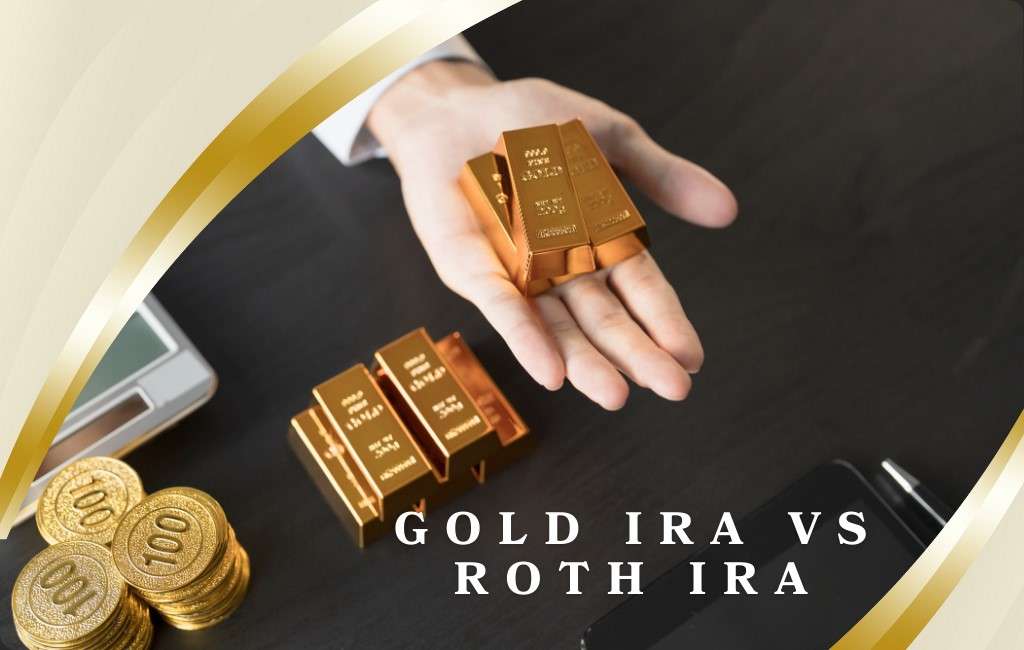
Gold IRA Vs Roth IRA
Choosing between a gold IRA and a Roth IRA comes down to how you want to grow and protect your retirement savings. Both accounts offer unique benefits, but they differ in structure, tax treatment, and the types of assets you can hold. Here’s a closer look at the key differences to help you make a confident investment decision.
Tax Treatment
A gold IRA works like a traditional IRA, meaning contributions may be tax-deductible depending on your income, and withdrawals in retirement are taxed as ordinary income. A Roth IRA, on the other hand, uses after-tax contributions. While you don’t get an upfront tax break, qualified distributions are tax-free, which makes Roth IRAs attractive for investors who expect higher taxes in the future.
Types of Investments
Gold IRAs focus on physical gold and other precious metals such as silver, platinum, and palladium. These assets must be stored in an IRS-approved depository and cannot be held personally by the account owner. A Roth IRA typically holds stocks, bonds, mutual funds, ETFs, and other market-based assets. This means a Roth IRA offers broader investment strategies, while a gold IRA is a niche option for those seeking to hold gold as part of a retirement plan.
Risk and Stability
Gold is often considered a hedge against inflation and market volatility. By investing in a gold IRA, you gain stability from owning actual gold that tends to hold value during economic uncertainty. A Roth IRA, tied to market-based assets, offers more potential for long-term growth but also comes with greater risk if markets underperform. Investors should weigh whether they prefer the security of gold or the growth opportunities of traditional market investments.
Contribution Rules
Both accounts follow IRS contribution limits, but Roth IRAs have additional income restrictions that may limit eligibility. For 2026, you can contribute up to $7,000 annually (or $8,000 if age 50+). However, high earners may not qualify for Roth IRA contributions. Gold IRAs do not have income caps, but the same annual contribution limits apply. This makes gold IRAs accessible for investors regardless of income level, while Roth IRAs may exclude some based on earnings.
Storage and Custodianship
A key difference with a gold IRA is the requirement to use an IRA custodian and an approved storage facility. Investors cannot keep physical possession of the gold themselves; it must be securely held in an approved depository. A Roth IRA doesn’t have this requirement since it invests in paper assets that remain in brokerage accounts. This difference means opening a gold IRA involves more setup and ongoing custodial fees compared to a Roth IRA.
How to Choose Between a Gold IRA Vs Roth IRA
Deciding between a gold IRA and a Roth IRA depends on your financial goals, risk tolerance, and how you envision your retirement. While both can play a role in a well-rounded retirement plan, here are some of the most popular tips experts suggest when weighing your options:
- Consider your tax outlook – If you expect to be in a higher tax bracket later, a Roth IRA may offer long-term advantages with tax-free withdrawals. If you prefer upfront tax deductions, a gold IRA structured as a traditional IRA could be more appealing.
- Evaluate your risk tolerance – Gold IRAs provide stability and act as a hedge against inflation, but they may lack the growth potential of market-based investments. Roth IRAs carry more market risk but often deliver stronger long-term returns.
- Think about diversification – Many investors use gold IRAs to add physical gold and other precious metals as part of a broader retirement strategy. A Roth IRA alone might not offer the same hedge against inflation or economic downturns.
- Account for fees and logistics – Gold IRAs involve storage and custodian fees since the gold must be kept in an IRS-approved facility. Roth IRAs are generally simpler to manage through a brokerage with fewer ongoing costs.
- Check contribution eligibility – High earners may not qualify to contribute directly to a Roth IRA, while gold IRAs have no income restrictions. Understanding these rules is crucial when planning your retirement contributions.
- Align with your retirement vision – If you want steady growth and flexibility with withdrawals, a Roth IRA may fit best. If you value holding tangible assets like gold and silver as part of your retirement security, a gold IRA could be the better investment option.
How to Invest in a Gold IRA
Getting started with a gold IRA may seem complex, but the process is fairly straightforward once you understand the steps. Here’s the common path most investors follow when setting up and funding a gold IRA:
- Choose a custodian – Select an IRS-approved IRA custodian or company that specializes in self-directed IRAs and precious metals. They will handle account setup and compliance.
- Open a gold IRA account – Complete the paperwork to establish your self-directed individual retirement account dedicated to holding physical gold and other precious metals.
- Fund the account – Add money by rolling over an existing IRA, transferring funds from a retirement account, or making direct contributions within IRS limits.
- Select your metals – Decide which types of physical gold (coins, bars, or bullion) you want to purchase. Some investors also include silver, platinum, or palladium.
- Make the purchase – Work with your custodian and a precious metals dealer to buy the gold. The transaction is made through your IRA, not personally.
- Arrange secure storage – The custodian ensures your metals are delivered to and stored in an IRS-approved depository. You cannot take physical possession yourself.
- Monitor your investment – Keep track of the gold price, market conditions, and account performance, adjusting your investment strategy as needed.
How to Invest in a Roth IRA
Investing in a Roth IRA is one of the simplest ways to start building long-term, tax-free retirement savings. Here’s the common process most investors follow when opening and contributing to a Roth IRA:
- Check eligibility – Make sure your income falls within the IRS limits for Roth IRA contributions. High earners may need to explore a backdoor Roth strategy.
- Choose a provider – Select a brokerage, bank, or financial institution that offers Roth IRAs. Look for low fees, a wide range of investment options, and strong customer support.
- Open your account – Complete the application by providing personal information and linking a bank account to fund contributions.
- Fund the Roth IRA – Contribute up to the annual limit ($7,000 for 2026, or $8,000 if you’re age 50+). Contributions are made with after-tax dollars.
- Pick your investments – Decide how to allocate your Roth IRA funds. Options include stocks, bonds, ETFs, mutual funds, or other investment strategies, depending on your goals and risk tolerance.
- Set up automatic contributions – Many investors schedule recurring transfers to build consistency and grow their Roth IRA over time.
- Monitor and adjust – Review your portfolio regularly, rebalance when needed, and adjust your strategy as your retirement plan and financial goals evolve.
Final Thoughts
In the end, the choice between a gold IRA and a Roth IRA depends on your priorities—whether you want the stability of holding physical gold or the long-term tax advantages of Roth contributions. Both accounts can strengthen your retirement plan, and some investors even use a combination for added balance.
If you’re still unsure which path suits you best, take the time to compare your options and seek guidance tailored to your financial goals. For more insights, check out how to get started with the right IRA for your future.
Frequently Asked Questions
Can I have both a gold IRA and a Roth IRA?
Yes, you can open and contribute to both as long as you stay within the IRS annual contribution limits across all your IRA accounts combined.
Are gold IRAs insured like bank accounts?
No, gold IRAs are not FDIC-insured. However, the depositories that store your physical gold typically carry insurance to protect against theft or loss.
What types of gold are allowed in a gold IRA?
Only IRS-approved gold products such as certain bullion bars and specific coins qualify. Collectible or rare coins generally aren’t permitted.
Can I take physical possession of gold from my gold IRA?
Not while the gold is inside your IRA. The metals must stay in an IRS-approved depository. You can only take physical possession after distribution, which may trigger taxes or penalties.
What happens to my Roth IRA after I retire?
You can withdraw funds tax-free at age 59½, provided you’ve had the account for at least five years. Unlike traditional IRAs, Roth IRAs do not require minimum distributions during your lifetime.
Can I roll over a 401(k) into a gold IRA or Roth IRA?
Yes, many investors roll over funds from a 401(k) into either type of IRA. The process must follow IRS rules to avoid taxes or penalties.
Are there penalties for early withdrawals?
Yes. With gold IRAs, early withdrawals before age 59½ are taxed as ordinary income and may include a 10% penalty. With Roth IRAs, contributions can be withdrawn anytime, but earnings withdrawn early may be penalized unless exceptions apply.